SiC vs IGBT Modules: Total Cost of Ownership Analysis
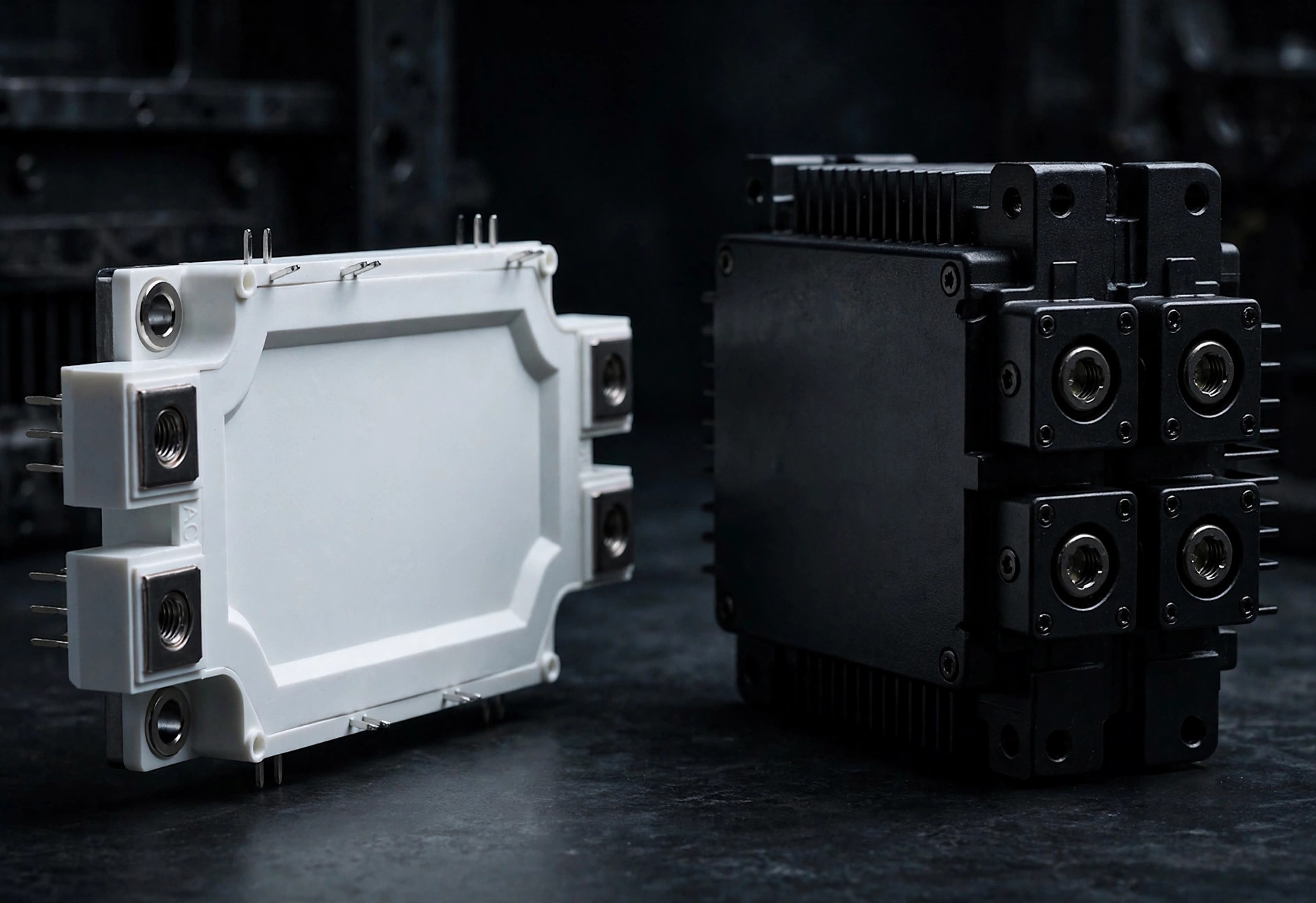
Total cost of ownership (TCO) is the complete cost of a power converter over its life: power semiconductors, magnetics, capacitors, heatsinks and cooling, enclosure, manufacturing, installation, energy losses during operation, and maintenance. Comparing a SiC MOSFET module against an IGBT module on device price alone is the most common — and most misleading — way to evaluate the two technologies.
This article breaks down where SiC actually saves money, where it costs more, and how to run the numbers for your application. All figures below are illustrative orientations to show the structure of the analysis, not quotes or measured data.
Why does the device price mislead?
A SiC MOSFET module typically costs a multiple of an equivalent-current IGBT module — the premium reflects more expensive substrates, more demanding fabrication, and smaller production volumes. If the bill of materials stopped at the power module, IGBT would win every time.
But the power module is usually only 10–25% of a converter’s total manufactured cost. The rest — magnetics, capacitors, thermal hardware, enclosure, labor — all respond to the module’s performance. SiC changes the size, loss, and frequency of everything around it, and that is where the economic case is built.
Where do system-level savings come from?
Smaller magnetics. SiC’s low switching losses allow 2–5× higher switching frequencies than IGBTs in the same application. Inductor and transformer size scales inversely with frequency, so magnetics shrink dramatically — less copper, less core material, less weight. In a 60 kW charger stage moving from 20 kHz to 60 kHz (illustrative), the main inductor can shrink by roughly half, with proportional savings in copper and enclosure volume.
Reduced cooling. Lower total losses mean smaller heatsinks, slower fans (or no fans), and in some designs the elimination of liquid cooling. Cooling hardware, its assembly labor, and its reliability burden all decrease. For sealed outdoor equipment like solar inverters and chargers, dropping a fan or shrinking a heatsink also improves ingress-protection design and long-term reliability.
Smaller DC-link and filter capacitors. Higher switching frequency reduces ripple current requirements, allowing smaller capacitor banks — meaningful because film capacitors are bulky and expensive.
Smaller enclosure, lower freight and installation cost. A 30–50% volume reduction (illustrative, application-dependent) cascades into smaller cabinets, lower shipping weight, easier installation, and in vehicles, less mass to carry. For solar farms, smaller and lighter inverters cut mounting structure and labor costs per megawatt.
Simplified topologies. SiC enables topologies that are impractical with IGBTs — for example, hard-switched high-frequency stages that would be too lossy in silicon — eliminating entire conversion stages or bulky line-frequency transformers in some designs.
How do lifetime energy losses change the math?
For equipment that runs thousands of hours per year, efficiency differences compound relentlessly. Consider the structure of the calculation (illustrative numbers):
| Factor | IGBT design | SiC design |
|---|---|---|
| Power module cost | baseline (lower) | higher (premium) |
| Magnetics + capacitors | larger, heavier | smaller at higher fsw |
| Heatsink / cooling | larger | smaller |
| Enclosure + freight + install | larger footprint | more compact |
| Peak efficiency (illustrative) | ~97% | ~98–98.5% |
| 10-year energy loss cost | higher | lower — scales with operating hours and electricity price |
The energy-loss row deserves emphasis: at 100 kW output, a 1% efficiency difference is 1 kW of continuous loss. Over 8,000 operating hours per year at an illustrative €0.15/kWh, that is €1,200 per year — €12,000 over a decade, per 100 kW of capacity. Multiply across a solar farm or a charging network and the SiC premium is recovered several times over. Your actual numbers will differ; the point is that the calculation must include operating energy, or it is incomplete.
How to run the TCO comparison for your design
A credible analysis needs these inputs:
- Device cost delta — quoted prices for both module options at your volume.
- Passive component sizing — magnetics and capacitor designs at each technology’s realistic switching frequency, with supplier quotes.
- Thermal design cost — heatsink, fans or cold plate, TIM, and assembly labor for each loss level.
- Efficiency curves — measured or modeled across your real load profile, not just peak efficiency. Partial-load efficiency often favors SiC more than the peak number suggests.
- Operating profile — hours per year, load distribution, electricity cost, and expected product lifetime.
- NRE and requalification — engineering effort, testing, and certification cost of the new design, amortized over your production volume.
Steps 1–5 usually favor SiC increasingly as power, operating hours, and energy costs rise. Step 6 is SiC’s headwind: if your IGBT platform is mature and volumes are modest, requalification cost can dominate. Be honest about it.
When does IGBT still win?
SiC is not universal. IGBT remains the rational choice when:
- Switching frequency is low (below ~10 kHz): motor drives at 4–8 kHz gain little from SiC’s switching advantage, though conduction-loss benefits at partial load can still matter.
- Cost dominates and efficiency is “good enough”: price-sensitive consumer or appliance applications with short operating hours.
- The platform is amortized: an existing, qualified, high-volume IGBT design where requalification cost exceeds the TCO gain.
- Ruggedness requirements favor silicon: some ultra-harsh short-circuit and overload regimes are still more forgiving in IGBTs, though modern SiC modules have closed much of the gap.
- Supply chain constraints: for programs that cannot tolerate any single-source risk and need the deepest multi-vendor IGBT ecosystem.
The honest engineering answer is a crossover analysis, not a technology religion. Run the six inputs above, and the right choice usually becomes obvious.
SiC Module Lab helps customers build this exact comparison — module quotes, loss modeling support, and samples for efficiency testing. Send your operating profile and target specs to request an RFQ at /contact/.
Next steps
Build the six-input TCO model for your application before choosing a technology: device quotes, passive sizing at realistic frequencies, thermal hardware, efficiency across your load profile, operating hours and energy cost, and requalification budget. If you want help structuring the loss and efficiency side of that model, contact our engineering team — it is the analysis we do every day.
Frequently asked questions
Is SiC cheaper than IGBT at the system level?
Often yes, despite higher device prices. System-level savings come from smaller magnetic components at higher switching frequency, reduced heatsink and cooling requirements from lower losses, and lower energy costs over the product's operating life. The crossover depends on power level, operating hours, and electricity cost.
How do lifetime energy losses affect the SiC vs IGBT decision?
In continuously operated equipment like solar inverters or chargers, even a 1% efficiency gain compounds into significant energy savings over a 10–20 year life. At high utilization and high electricity prices, lifetime energy savings alone can exceed the SiC price premium.
When does IGBT still beat SiC?
IGBT remains the better choice for low switching frequencies (below ~10 kHz), cost-driven high-volume applications with modest efficiency requirements, and designs where the existing IGBT platform is fully amortized and efficiency gains don't justify requalification.
Need samples or a cross-reference check?
Tell us your target application and ratings — our engineers will recommend the right SiC module and arrange samples.
Request Samples