62mm vs 34mm SiC Power Modules: Package Comparison
62mm vs 34mm SiC module comparison: footprint, current capability, thermal performance, and application fit for EV charging, solar, and drives.
Read article →Your SiC Power Module Sourcing Partner from China — selection guides, pin-to-pin cross-references, stock availability and fast samples, built for power-electronics engineers.
EV charging, solar inverters, energy storage, motor drives, UPS and data-center power — find the right module for your topology.
Browse applications →650V, 750V, 1200V, 1700V and 2000V SiC modules — match blocking voltage to your DC bus with proper derating margin.
Browse voltages →62mm, 34mm, EasyPACK and more — industry-standard footprints that make pin-to-pin replacement straightforward.
Browse packages →Looking for a second source or a cost-competitive alternative? Start with the industry-standard 62mm footprint.
| Original P/N | Our Equivalent | Pin-to-pin | Key Differences | Notes |
|---|---|---|---|---|
| SAMPLE-62-1200-A | EQ-62-1200-A | Yes | Same footprint | Illustrative row |
| SAMPLE-62-1200-B | EQ-62-1200-B | Yes | Lower Rds(on) | Illustrative row |
| SAMPLE-62-1200-C | EQ-62-1200-C | Verify | Gate drive window differs | Illustrative row |
| SAMPLE-62-1200-D | EQ-62-1200-D | Yes | Same footprint | Illustrative row |
| SAMPLE-62-1200-E | EQ-62-1200-E | Verify | NTC characteristics differ | Illustrative row |
| SAMPLE-62-1200-F | EQ-62-1200-F | Yes | Same footprint | Illustrative row |
62mm vs 34mm SiC module comparison: footprint, current capability, thermal performance, and application fit for EV charging, solar, and drives.
Read article →Replace original SiC modules with pin-to-pin alternatives: methodology for electrical verification, gate-drive, thermal, and qualification checks.
Read article →SiC module selection guide: five engineering steps covering voltage rating, current rating, package, thermal design, and gate drive compatibility.
Read article →SiC power modules for EV charging and solar inverters: topologies, voltage classes, and design benefits for fast chargers and 1500V PV systems.
Read article →Full-SiC MOSFET half-bridge modules, 650V–1700V, in 62mm, 34mm and EasyPACK industry-standard packages.
Isolated gate drivers with desaturation protection and high CMTI, engineered for fast-switching SiC stages.
Op-amps, motor drivers and power-management parts that complete the system around a SiC power stage.
Power management and signal-chain ICs for reliable SiC-based power systems.
A silicon carbide (SiC) power module is a power module that uses SiC MOSFETs as switching devices instead of silicon IGBTs. It converts electrical power with very high efficiency thanks to SiC's wide bandgap, which enables lower switching losses, higher switching frequencies, higher junction temperatures and higher blocking voltages than silicon devices.
SiC MOSFET modules switch much faster and with far lower switching losses than IGBT modules, allowing higher switching frequencies, smaller magnetics and heatsinks, and higher power density. IGBTs remain cost-competitive at lower switching frequencies and in price-sensitive applications, but SiC wins on system-level efficiency and size in EV chargers, solar inverters and high-frequency power supplies.
Follow five steps: 1) define your DC bus voltage and pick a blocking voltage with margin (e.g. 1200V devices for 800V systems); 2) calculate RMS and peak current including overload; 3) set your switching frequency and estimate total losses; 4) choose the package (62mm, 34mm, EasyPACK) that fits your thermal and mechanical design; 5) verify gate-drive compatibility and qualification requirements.
The most common ratings are 650V, 750V, 1200V, 1700V and 2000V. 1200V is the workhorse for EV charging, solar and industrial drives; 650V/750V serve lower-voltage systems and data-center power; 1700V and 2000V target high-power industrial, rail and grid applications. Always leave voltage derating margin above your maximum DC bus.
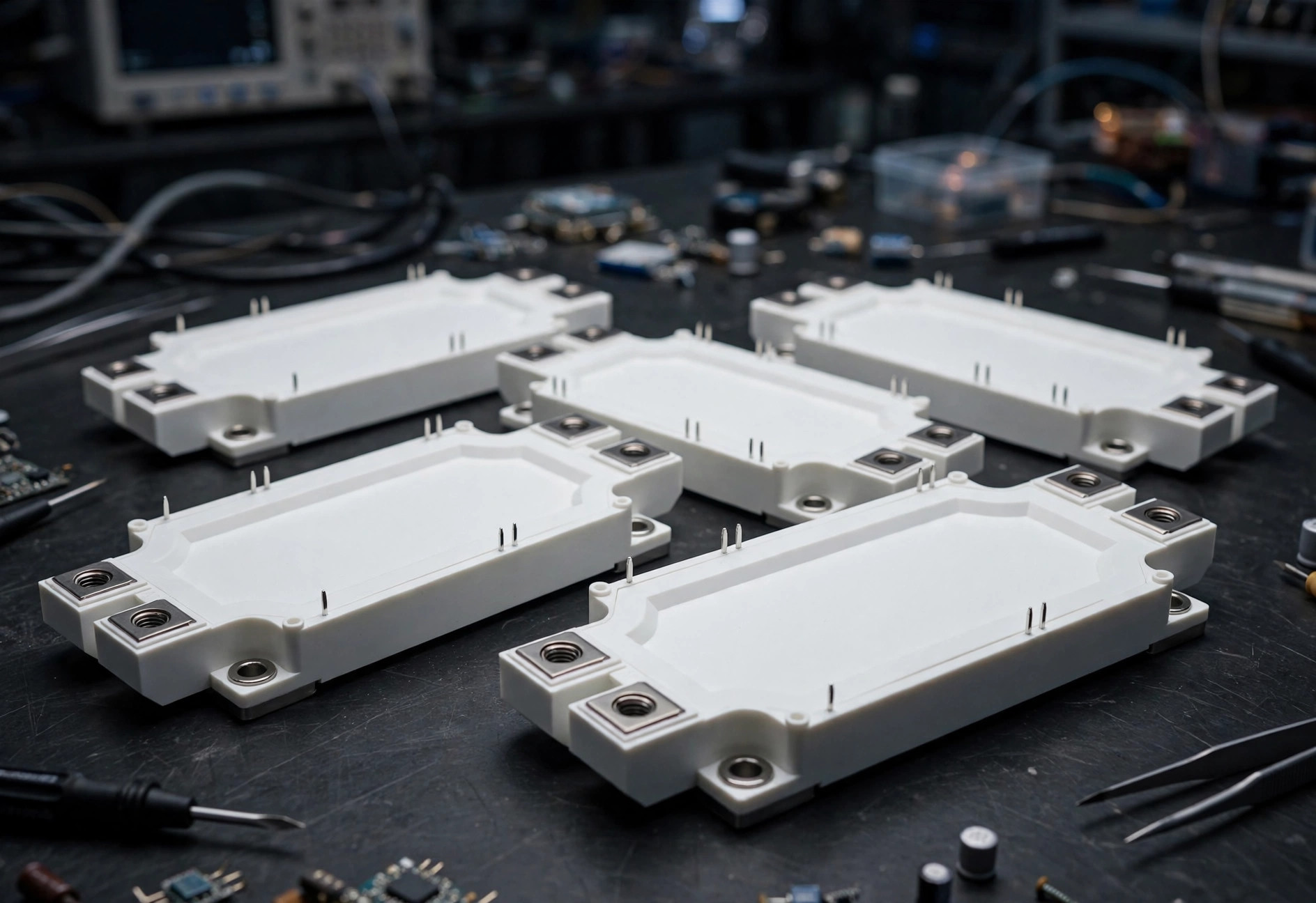
The 62mm package is the industry-standard high-power housing (up to several hundred amps), while 34mm is its smaller sibling for medium power. Both use the same 62/34mm footprint conventions across vendors, which makes pin-to-pin replacement practical. 62mm suits EV chargers and solar inverters; 34mm fits compact drives and auxiliary power supplies.
Send us your target part number, application and annual volume. Our engineers will confirm the pin-to-pin equivalent and arrange samples.
Request Samples / RFQ